

Choosing between a chain drag conveyor vs flexible screw conveyor starts with understanding the material being handled. Both systems transport dry bulk solids through enclosed pathways, but they differ in how they move material, accommodate plant layouts, and respond to abrasion, particle fragility, and cleaning requirements.
For processing facilities evaluating mechanical conveying equipment, the most useful comparison considers material properties, required throughput, conveying route, maintenance needs, and total cost of ownership.
How Do Chain Drag and Flexible Screw Conveyors Work?
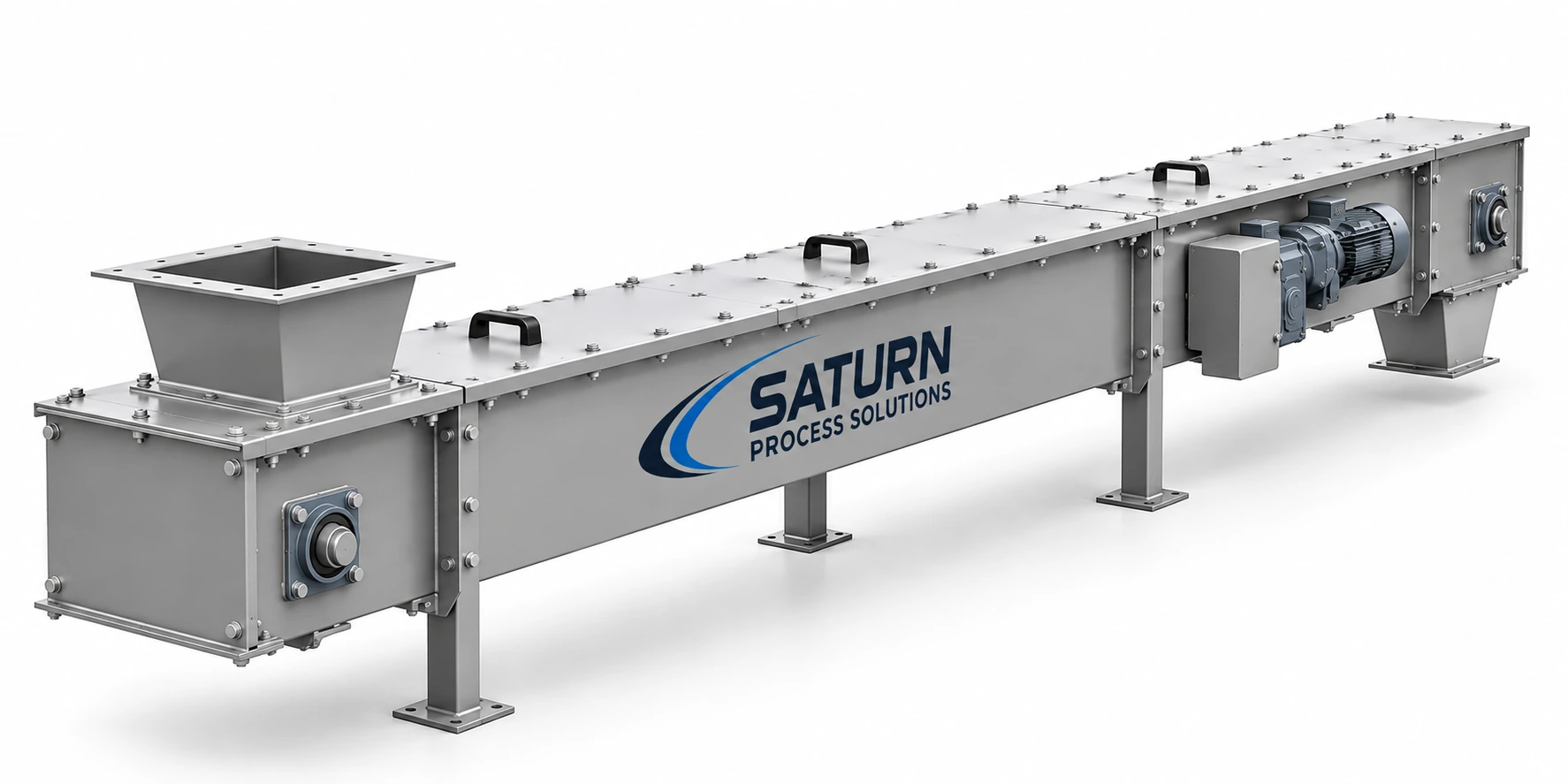
Chain Drag Conveyors
A chain drag conveyor uses a continuous chain fitted with flights to move bulk material through an enclosed housing. Its relatively low-speed, high-torque operating principle can make it a suitable choice for demanding materials and applications where controlled movement and particle integrity matter.
Common application candidates include minerals, glass batch, metal powders, dense pellets, and some fragile flakes. Suitability depends on the material’s actual characteristics and the conveyor’s construction.
Potential advantages include enclosed material transfer, configurations with multiple inlets or discharge points, and relatively gentle conveying in appropriately designed systems.
Design considerations include chain tensioning, lubrication where required, access for inspection, space requirements, and the limitations of steep vertical routing.
Flexible Screw Conveyors
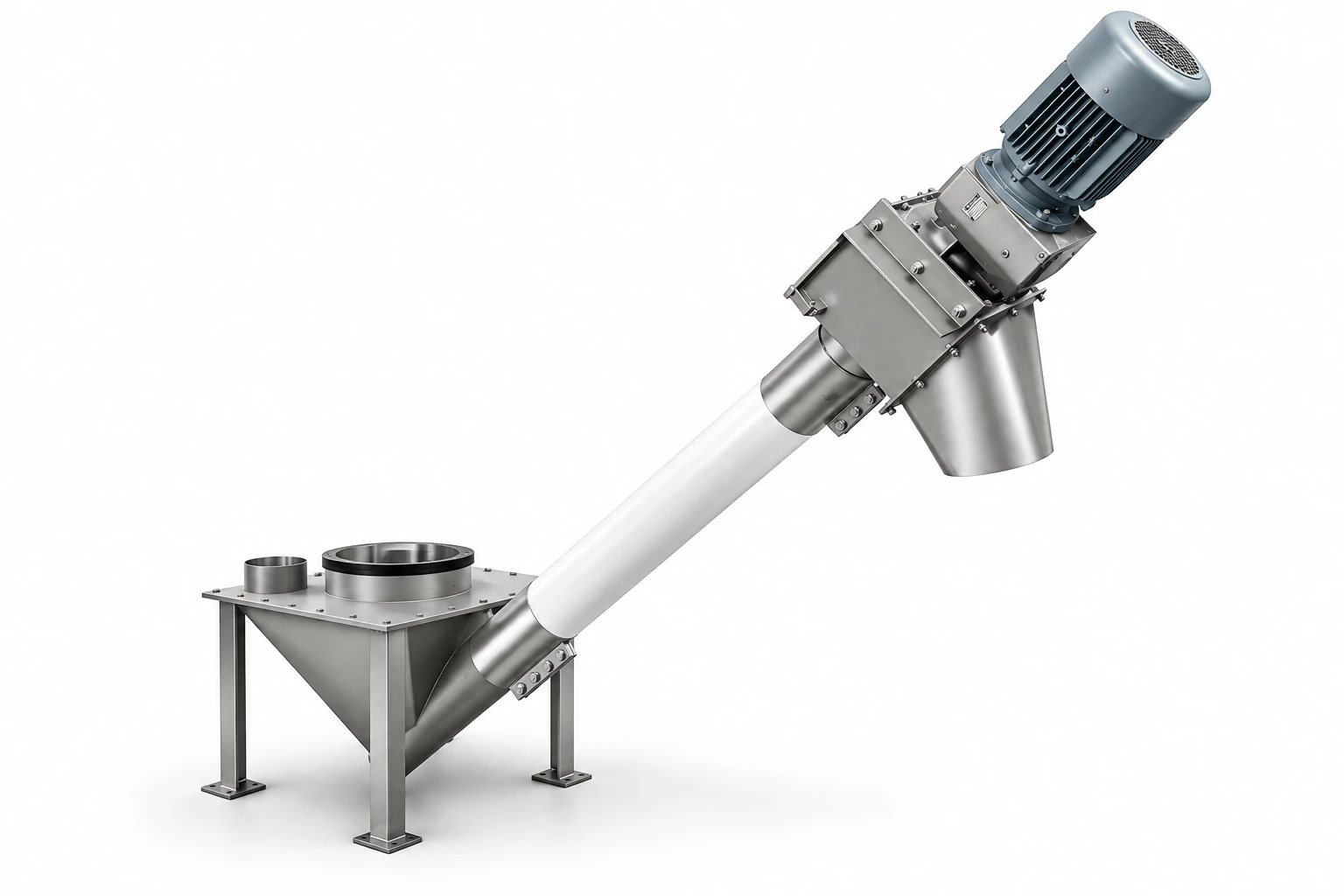
A flexible screw conveyor uses a rotating helical screw, typically inside a polymer tube, to move material through a compact conveying route. The system can accommodate curved or inclined paths and is commonly considered for transferring free-flowing powders and granules to downstream processing or packaging equipment.
Typical candidates include flour, sugar, salt, plastic pellets, and other dry ingredients, subject to testing for flowability, abrasion, and product sensitivity.
Potential advantages include a compact footprint, relatively straightforward installation, adaptable routing, and accessibility for cleaning in designs intended for frequent disassembly.
Design considerations include screw and tube wear, potential particle degradation, conveying distance and lift limitations, and how material properties affect consistent delivery.
Chain Drag Conveyor vs Flexible Screw Conveyor: Comparison Table
| Selection factor | Chain drag conveyor | Flexible screw conveyor |
|---|---|---|
| Material suitability | Often considered for abrasive, dense, or fragile materials | Often considered for free-flowing powders and granules |
| Typical capacity range | Medium to high, depending on design | Low to medium, depending on design |
| Particle integrity | Can provide gentle handling at suitable speeds | Rotating screw may affect sensitive products |
| Routing | Horizontal and moderate-incline layouts | Curved, inclined, and some steep-lift layouts |
| Cleaning and sanitation | Requires attention to housing and chain access | Some designs allow relatively quick disassembly |
| Maintenance focus | Chain, flights, tension, and associated components | Screw, tube, and drive components |
| Initial equipment cost | Often higher for comparable duties | Often lower for suitable light-duty applications |
These are general engineering tendencies, not guaranteed specifications. Final selection should be based on the material, required duty, equipment configuration, and supplier data.
Five Factors That Determine the Better Fit
1. Material Flowability and Bulk Density
Start with the material’s flow behavior, bulk density, moisture content, and tendency to compact or bridge. A conveyor that performs well with free-flowing granules may behave differently with cohesive powders or heavy, dense products.
2. Abrasion and Particle Fragility
Abrasive materials can accelerate component wear, while fragile products may break down during transfer. Chain drag conveyors are often evaluated for abrasive or delicate products; flexible screw conveyors require careful review where screw contact could affect particle integrity.
3. Required Throughput and Conveying Route
Establish the required mass flow rate, conveying distance, lift height, available floor space, and number of pickup or discharge points. Chain drag systems are often suited to horizontal and moderate-incline routes; flexible screw systems can offer layout flexibility where a compact curved or inclined route is needed.
4. Dust Control and Cleaning
Both conveyor types can be enclosed to help contain material during transfer. Actual dust-control performance depends on inlet and outlet connections, seals, operating conditions, and integration with the facility’s dust-management system. Where frequent product changeovers are expected, cleaning access should be evaluated early.
Dust control is also an important safety consideration when conveying materials that may generate combustible dust. OSHA’s guidance on combustible dust hazards emphasizes minimizing dust releases from processing equipment, maintaining effective housekeeping practices, and evaluating appropriate protective measures for the materials being handled.
5. Maintenance and Lifecycle Cost
Compare more than purchase price. Consider expected wear, inspection access, replacement parts, cleaning time, operating hours, and downtime risk. Energy consumption also depends on the specific duty and system design; it should be evaluated using application-specific equipment data rather than conveyor type alone.
Integrating Conveyors With Other Bulk Handling Equipment
Mechanical conveying equipment is often part of a larger process. A conveyor may receive material from a bulk bag discharger, transfer it to a mixer or blender, or feed downstream packaging equipment. The selected technology must match the upstream discharge characteristics and the downstream process requirements.
Saturn Process Solutions can review conveyor selection as part of a broader bulk material conveying system, including interfaces with other equipment.
Frequently Asked Questions
Which conveyor is better for abrasive dry bulk materials?
A properly specified chain drag conveyor is often a strong candidate for abrasive materials. However, wear resistance depends on component materials, operating speed, particle properties, and maintenance practices.
Can a flexible screw conveyor move powder vertically?
Flexible screw conveyors can be configured for inclined and, in some applications, steep-lift conveying. The achievable lift and capacity depend on the powder, screw and tube geometry, and equipment design.
Which conveyor has the lower total cost?
Flexible screw conveyors may have a lower initial cost for suitable duties, while chain drag systems may be advantageous for other operating conditions. The best value depends on wear, maintenance, product handling, throughput, and the expected service life.
Conclusion: Select the Conveyor Around the Application
Chain drag conveyors can be a robust choice for challenging dry bulk materials, particularly where controlled movement, durability, and higher-capacity conveying are priorities. Flexible screw conveyors can be attractive for compact layouts and suitable free-flowing powders or granules.
Neither technology is the right answer for every plant. A sound equipment decision begins with representative material information, realistic throughput targets, a defined conveying route, and an evaluation of lifecycle costs.
Planning a conveying project? Contact Saturn Process Solutions to request an application review or quote.